When Music Becomes the Story
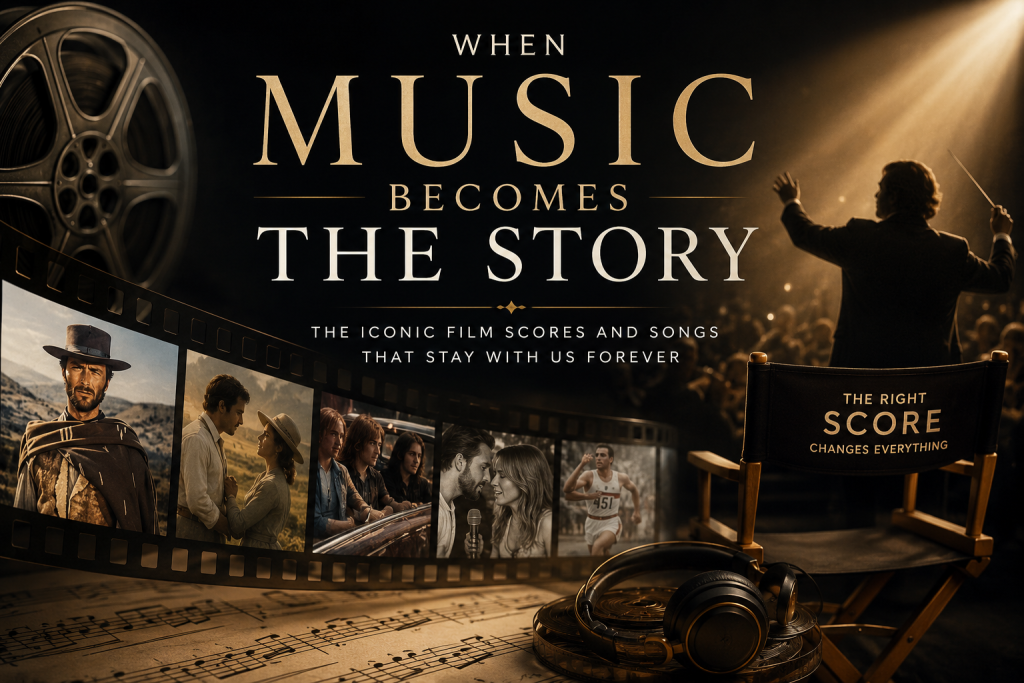
There are films we remember for the performances. Others for the cinematography or the script.
But every so often, it’s the music that stays with us long after the credits have rolled. A few notes are enough to transport us back to a moment, a landscape or an emotion that words alone could never capture.
Some of my favourite films have achieved exactly that.
One composer who stands above almost everyone else is Ennio Morricone. His score for The Good, the Bad and the Ugly is instantly recognisable. Those haunting whistles, soaring vocals and unforgettable themes transformed what could have been a traditional western into cinematic legend. Morricone didn’t simply accompany the action. He became another character in the film.
I was fortunate enough to meet Morricone while filming Making It in Hollywood. It remains one of those rare encounters where you realise you’re in the presence of someone whose work has shaped generations of filmmakers and audiences alike. His quiet humility contrasted beautifully with the enormous impact of his music.
Few scores evoke grandeur quite like John Barry’s music for Out of Africa. The sweeping orchestral themes mirror the vast African landscapes while capturing the romance, longing and melancholy of the story. Whenever I hear those opening bars, I can almost see the light breaking over the Kenyan plains. It’s majestic in every sense of the word.
Sometimes, however, it’s not an original score that defines a film, but a perfectly chosen song. Almost Famous is a masterclass in using music to tell a story. Cameron Crowe’s soundtrack doesn’t simply provide a backdrop. It captures the spirit of the 1970s, the exhilaration of youth and the emotional journey of every character. The unforgettable scene where the band silently reconnects as Tiny Dancer fills the tour bus remains one of cinema’s most heartfelt moments. You don’t just watch it. You feel it.
That emotional connection reached another level with A Star Is Born. The performance of Shallow by Lady Gaga and Bradley Cooper is remarkable on screen, but seeing it performed live at the Academy Awards was something truly special. It was intimate, raw and utterly captivating, reminding us that great film music can stand proudly on its own beyond the cinema.
No discussion of iconic film music would be complete without Vangelis and Chariots of Fire. His synthesiser-led score became one of the most recognisable pieces of film music ever written. It captures determination, triumph and aspiration with extraordinary simplicity.
One of the most memorable tributes to that music came during the 2012 Summer Olympics, when Rowan Atkinson appeared as Mr Bean alongside the London Symphony Orchestra. His wonderfully understated comedy, interrupting such an iconic piece of music with perfectly timed humour, was pure British genius. It showed that even the most revered film scores can be celebrated with warmth, affection and laughter.
The greatest film music doesn’t simply support the story. It becomes inseparable from it. Decades later, we may forget individual lines of dialogue, but the opening notes of Morricone, Barry or Vangelis immediately transport us back to where we first experienced those films.
That’s the magic of cinema.
Sometimes the most powerful performance isn’t delivered by an actor at all. Sometimes it’s delivered by the orchestra.