AI Is Coming for Hollywood. But What Exactly Is It Replacing?
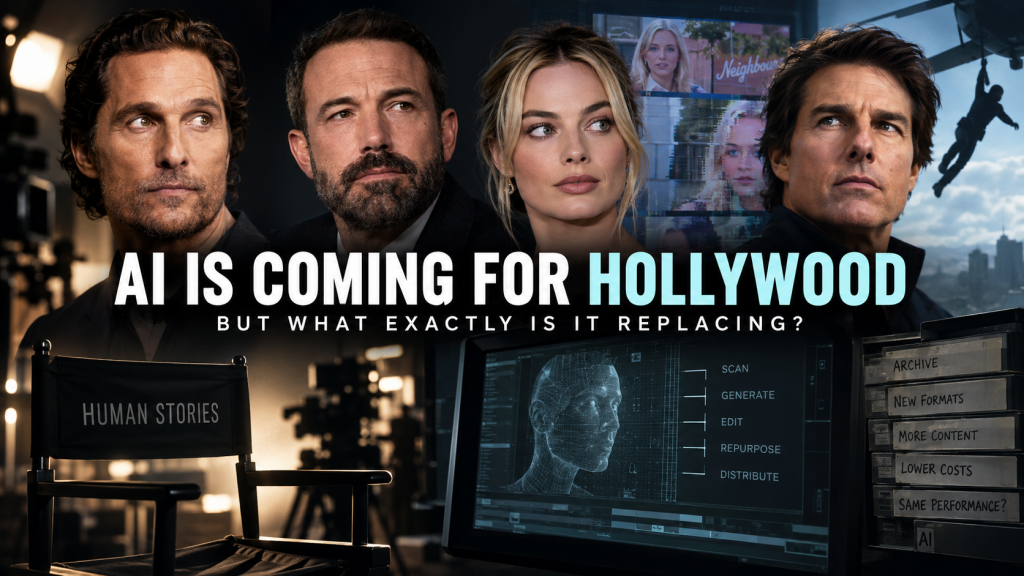
Matthew McConaughey says actors need to protect their identities from AI. Tom Cruise believes audiences still want to see something real. Ben Affleck says he doesn’t worry about Skynet and regards AI as another form of computing. Meanwhile, performances by Margot Robbie from Neighbours are being repurposed into a new short-form product with the help of AI. Hollywood’s argument over artificial intelligence is no longer theoretical, but perhaps we are still asking the wrong question.
Artificial intelligence has become one of the most divisive subjects in filmmaking. For some, it promises cheaper visual effects, faster post-production and creative possibilities previously available only to studios with enormous budgets. For actors, writers, visual-effects artists and other creative professionals, the same technology raises questions about employment, ownership, consent and what happens when decades of existing work become material that can be analysed and repurposed by machines.
Part of the problem is that almost everything is now being placed under the same “AI filmmaking” label. Using AI to remove a stunt wire or extend a set is not the same as generating an actor. Creating an authorised digital double is not the same as cloning somebody’s voice without permission. Nor is using machine learning within a visual-effects pipeline equivalent to asking a generative model to create an entire scene. Separating performance from visual effects makes the debate considerably clearer.
Ben Affleck and the Optimistic Case for AI
Ben Affleck recently offered one of Hollywood’s more positive assessments. Speaking at Bloomberg’s Screentime event, he said he doesn’t “worry about Skynet” and doesn’t believe AI will take over the entertainment business in any meaningful way. He described it as “another form of computing” and placed it within the long history of technological advances adopted by film and television.
Affleck is hardly a disinterested observer. He founded InterPositive, an AI filmmaking company subsequently acquired by Netflix, and now advises the streamer. The technology he has discussed is largely concerned with production and post-production problems such as correcting lighting, reframing shots, removing stunt wires and dealing with missing material. Seen in that context, his argument is understandable. These are tools intended to help filmmakers manipulate images rather than manufacture replacement actors.
Where his optimism becomes more debatable is in the effect those tools could have on employment. AI doesn’t have to take over filmmaking to transform the number and types of people required to make a film. If ten people can eventually accomplish work that previously required 50, the technology has changed the industry even if a human director remains firmly in control.
Margot Robbie and the Value of an Old Performance
A particularly interesting example has emerged from Neighbours. Long before Barbie and The Wolf of Wall Street, Margot Robbie played Donna Freedman in the Australian soap between 2008 and 2011. Fremantle has now partnered with RoseBerry Media to turn storylines from the programme’s archive into vertical micro-episodes, with the first releases concentrating on two storylines featuring Robbie.
RoseBerry’s RedSnapper technology uses AI to analyse archive material, identify characters and storylines, restructure footage and adapt conventional television programmes for vertical viewing. This is not an artificially generated Margot Robbie performing newly created scenes. It is the real Robbie’s existing performance being used as part of a newly formatted entertainment product.
The distinction matters, but so do the questions it raises. Actors recorded performances under contracts negotiated for the media landscape of their time. AI increasingly makes it possible to search, analyse, restructure, localise and repackage enormous archives in ways that could scarcely have been anticipated when those performances were made. Veteran Neighbours actor Stefan Dennis has criticised the project and raised concerns about performers’ rights and livelihoods, bringing the issue of consent and compensation firmly into the discussion.
Matthew McConaughey and Owning Your Identity
Matthew McConaughey approaches the problem from the perspective of the performer. His message to younger actors has been pragmatic. AI is already here, so simply objecting to it will not prevent its development. Instead, actors need to think seriously about ownership of their voice, face, likeness and other characteristics that make their identity commercially valuable.
McConaughey has followed that principle himself, seeking trademark protection around aspects of his identity while also embracing authorised uses of AI. He is an investor in ElevenLabs and has used an AI version of his own voice for a Spanish-language version of his newsletter. His position is therefore neither straightforwardly pro-AI nor anti-AI. He is arguing that the performer should retain control over when and how a digital version of themselves is used.
That position becomes particularly significant when applied beyond major stars. McConaughey, Robbie, Cruise and Affleck have considerable negotiating power. Background performers, voice actors, stand-ins and supporting artists may not. The greatest disruption to acting could therefore occur some distance below the names on the poster.
Tom Cruise and the Human Premium
Tom Cruise offers another perspective. Speaking at BAFTA’s Life in Pictures, he acknowledged that AI is coming but argued that audiences still “want to see real things.” It is a particularly appropriate argument from an actor whose Mission Impossible films increasingly sell themselves on the physical reality of what audiences are watching.
Cruise actually hangs from aircraft, jumps from cliffs and performs elaborate physical stunts. The films frequently show audiences how those sequences were achieved because knowing that the actor really did them has become part of the entertainment. AI may eventually create an entirely convincing image of an actor hanging from an aircraft, but technical perfection does not necessarily make the experience equivalent. The knowledge that something actually happened can itself have value.
As synthetic imagery becomes harder to distinguish from photography, that value could increase. We may eventually see something resembling a human premium, where productions actively promote the fact that performances, stunts or locations are real precisely because audiences can no longer assume that they are.
Acting and Visual Effects Need Different Conversations
The argument changes significantly when we move away from performance and into visual effects. Cinema has always manipulated reality through matte paintings, miniatures, optical compositing, animatronics, CGI, digital compositing and virtual production. AI can reasonably be considered another major development in that technological progression.
If AI removes a stunt harness, extends a landscape, corrects lighting or repairs continuity, it does not necessarily interfere with the actor’s performance at all. This is where Affleck’s argument is strongest. For independent filmmakers in particular, generative technology could make images possible that previously required millions of pounds and hundreds of specialists.
That opportunity is genuinely exciting, but the economic consequences cannot simply be separated from the creative possibilities. The millions no longer required to create a particular sequence previously paid visual-effects artists, technicians and other specialists. Traditional CGI may be digital, but it is still extremely labour intensive. Artists build models, textures, rigs, animation, lighting and composites, often making thousands of individual creative decisions. Generative AI potentially shifts some of that process from constructing an image to directing, selecting and refining machine-generated alternatives.
For independent cinema, that could represent an extraordinary democratisation of filmmaking. For people currently employed to produce those images conventionally, it understandably looks rather different.
The Question Hollywood Actually Faces
McConaughey, Cruise and Affleck are therefore not necessarily contradicting each other because they are addressing different parts of the transformation. McConaughey is concerned with ownership and the ability of performers to control their identities. Cruise is defending the value of authentic human performance. Affleck sees AI primarily as another generation of filmmaking tools capable of making production faster and more flexible.
The Neighbours project introduces another dimension by showing what may happen to the enormous archive of performances already owned by studios and production companies. AI doesn’t need to generate a new Margot Robbie to change the economics surrounding Margot Robbie’s work. The ability to analyse and repurpose existing performances at scale creates questions that contracts written years or decades ago may never have contemplated.
Perhaps, then, the wrong question is whether AI will replace filmmakers. There are too many different jobs, technologies and creative decisions hidden inside that word.
Removing a stunt wire is not the same as replacing a visual-effects artist. Generating a background is not the same as replacing a background performer. Reframing an old performance isn’t the same as generating an actor, but it still raises questions about what can be done with that performance years later. Creating a convincing image of Tom Cruise performing a stunt is not necessarily equivalent to Tom Cruise actually doing it.
Affleck may be right that Hollywood doesn’t need to worry about Skynet. But it doesn’t require a science-fiction superintelligence to profoundly change filmmaking. It only requires software capable of doing enough things previously done by people, quickly and cheaply enough, for producers to reconsider how many of those people they still need.
That is a much less dramatic prospect than Skynet. For the filmmaking world, it may also be a much more important one.