Ben Affleck and Matt Damon Launch New Film Fund to Back the Next Generation of Independent Filmmakers
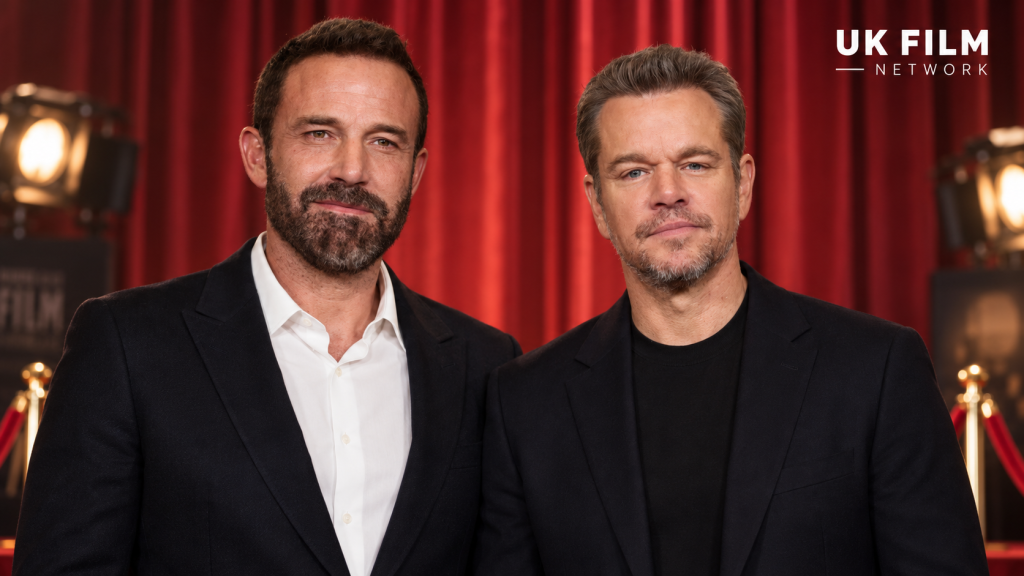
Hollywood stars Ben Affleck and Matt Damon are expanding their production company, Artists Equity, with a dedicated independent film division and financing fund designed to support emerging directors, develop original stories and give independent cinema a stronger presence in theatres.
Ben Affleck and Matt Damon have announced a significant new initiative aimed at supporting the next generation of filmmakers, launching Artists Equity Independent Pictures, a dedicated division of their production company backed by a new independent theatrical film fund.
The move represents a further expansion of Artists Equity, the company the two Oscar-winning actors established in 2022 alongside investment firm RedBird Capital Partners. Already responsible for a growing collection of theatrical and streaming productions, the company is now extending its ambitions into the independent sector, where securing finance, attracting established talent and finding distribution remain considerable challenges for emerging filmmakers.
The announcement, first reported by Variety on 7 October, arrives at an interesting moment for the film industry. Although streaming platforms have created new outlets for content, the economics of independent filmmaking remain difficult, with increasing competition for investment, uncertain theatrical prospects and growing pressure on production budgets. Against this backdrop, the involvement of two internationally recognised actors, supported by an established production infrastructure and dedicated investment capital, could provide a valuable new route for filmmakers looking to bring ambitious projects to the screen.
For Affleck and Damon, the initiative also represents something of a return to their own roots. Long before they became major Hollywood stars, the pair achieved their breakthrough with Good Will Hunting, the independently originated drama they wrote together and starred in, winning the Academy Award for Best Original Screenplay in 1998.
In announcing the new venture, the actors acknowledged the importance of independent cinema in developing their own careers, describing it as an essential environment for discovering talent, nurturing creative voices and finding audiences for stories that might otherwise struggle to secure mainstream backing.
A new financing model for independent cinema
Artists Equity Independent Pictures, known as AEIP, will operate with the support of its own independent theatrical film fund, concentrating on projects from emerging filmmakers. The division is intended to combine creative ambition with financial discipline, offering a framework in which original filmmaking can be supported without losing sight of commercial realities.
The division will be overseen day to day by Jennifer Westin, Artists Equity’s Senior Vice President of Creative Affairs and Production, working under Amy Baer, the company’s President of Film and Television.
While the financial size of the new fund has not been publicly disclosed, its creation is noteworthy because it extends an approach that has become central to Artists Equity’s identity. Rather than treating filmmaking talent simply as a production expense, the company has sought to build a business in which creative contributors can participate more directly in the financial success of their work.
In a new interview with Variety published on 8 October, Affleck explained that the company’s model seeks to compensate writers, directors, actors and producers in a manner closer to equity investors. The aim is to make financial participation more transparent and to establish a structure in which filmmakers can share in the economic value they help create.
The company has already experimented with this approach through productions including Air and the Netflix thriller The Rip. Artists Equity has also negotiated performance-related compensation arrangements that can extend beyond principal talent to members of the production crew.
Whether those arrangements will be applied in precisely the same form across the new independent division remains to be seen. Nevertheless, the principle of connecting creative contribution with financial participation is particularly relevant to independent filmmakers, many of whom accept reduced upfront remuneration in exchange for the opportunity to make their films.
First projects attract major acting talent
The new division is launching with an initial slate that combines emerging directors with established performers and experienced production partners.
Among its first projects is A Woman in the Sun, a family drama that will mark the feature directorial debut of screenwriter Julia Cox. Cox previously wrote the screenplay for Nyad, the 2023 biographical drama starring Annette Bening and Jodie Foster, and has also worked on The Love of Your Life, which attracted attention at the Toronto International Film Festival.
Her first feature as director has already assembled a notable cast, including two-time Academy Award winner Renée Zellweger, Oscar-winning actress Sissy Spacek and Mia Threapleton, whose recent credits include Wes Anderson’s The Phoenician Scheme.
The involvement of performers of this calibre in a debut feature illustrates one of the potential strengths of the Artists Equity model. Access to recognised actors can make an independent project considerably more attractive to financiers, distributors and international buyers, while giving a first-time director the opportunity to work with established industry professionals.
Another project in development is Downriver, which will mark the scripted feature directorial debut of Sam Jones, whose television work includes episodes of Ted Lasso. Jones has co-written the screenplay with bestselling novelist and journalist Carl Hiaasen, whose work is widely associated with crime, satire and the often eccentric characters of Florida.
The film is being developed with production involvement from Seth Caplan, Dori Rath, Joseph Restaino of Hungry Bull Productions and Michael London of Groundswell Productions. The additional producing and executive-producing partners suggest that the new division will draw upon established industry relationships rather than operate solely as an internal financing operation.
Although the two titles provide an early indication of the company’s ambitions, further details about production schedules, budgets and release arrangements have yet to emerge.
Building on the success of Artists Equity
Since its formation in November 2022, Artists Equity has developed an increasingly substantial presence in Hollywood, producing films across multiple genres and working with major theatrical distributors and streaming services.
Its first feature, Air, directed by Affleck and starring Damon alongside Viola Davis, Jason Bateman and Affleck himself, explored Nike’s pursuit of basketball player Michael Jordan and proved an effective introduction to the company’s artist-led production philosophy.
Subsequent projects have included The Instigators, Unstoppable, The Accountant 2, Small Things Like These and The Rip, establishing a varied portfolio of commercial films, dramas and independent-minded productions.
The company has also expanded into documentary production, television development and branded entertainment. In 2025, Artists Equity announced a three-year theatrical feature film agreement with Sony Pictures, strengthening its position within the traditional studio distribution system.
Its latest release, Animals, a political crime thriller directed, co-written by and starring Affleck, is due to arrive on Netflix on 9 October. The film also features Kerry Washington, Steven Yeun and Gillian Anderson.
Another forthcoming production, Free Byrd, stars Dwayne Johnson as a motorcycle stunt performer confronting a serious medical diagnosis while preparing for one final jump. It is directed by Greg Kwedar, whose acclaimed prison drama Sing Sing demonstrated the commercial and critical possibilities of character-driven independent cinema.
Taken together, these productions reveal a company attempting to work across the boundaries traditionally separating studio filmmaking, streaming entertainment and independent production.
Beyond financing: developing the filmmakers themselves
The launch of Artists Equity Independent Pictures is not the company’s only recent initiative aimed at developing creative talent.
In August 2026, Artists Equity announced the fourth edition of its Writers’ Room programme, an initiative designed to develop original screenplays through a structured process involving experienced writers and filmmakers.
Affleck, Damon and Oscar-winning screenwriter Eric Roth are involved in guiding the programme, with eight writers divided between two groups working over a 12-week development period.
The initiative provides a useful indication of the company’s broader strategy. Developing new talent involves more than simply providing production finance. Writers and directors need access to experienced collaborators, constructive editorial feedback, commercial insight and meaningful opportunities to move projects from development into production.
By establishing both talent development programmes and dedicated independent financing, Artists Equity is beginning to create a more integrated route through which emerging filmmakers might progress from original ideas to completed features.
The extent to which the two initiatives will work together has not yet been outlined publicly, but the combination offers an interesting example of how an established production business can invest in the creative pipeline rather than relying exclusively on projects already developed elsewhere.
What could this mean for British independent filmmakers?
For Britain’s independent film community, the announcement is worth watching closely, particularly given the longstanding connections between the UK and US film industries.
British filmmakers have traditionally depended upon a combination of public funding, private investment, international co-production, television partnerships and distribution advances to finance independent features. Organisations such as the BFI, BBC Film and Film4 continue to play an important role, but access to production capital remains a recurring challenge, especially for filmmakers attempting to progress from short films to their first or second feature.
The emergence of another well-capitalised independent film operation could potentially create additional opportunities for international co-productions, talent partnerships and English-language features developed outside the conventional Hollywood studio system.
There is, however, an important distinction between the launch of a fund and the availability of an open funding programme. Artists Equity has not announced a public application process, confirmed eligibility requirements or indicated whether the new division will actively accept submissions from filmmakers based in the UK.
British producers and directors should therefore regard the announcement as a potentially important industry development rather than an immediately accessible grant or investment scheme.
The new division’s early project choices suggest a development-led approach, built around promising directors, compelling material and established production relationships. That makes it more comparable to an independent production and financing company than a traditional film fund offering grants to applicants.
For UK filmmakers seeking international partners, the more significant question may ultimately be whether Artists Equity develops relationships with British producers, agents, financiers and distributors as its slate expands.
A response to a changing film industry
The wider importance of the announcement lies in what it says about the evolving relationship between filmmakers, investors and distributors.
Independent production has always involved a delicate balance between artistic ambition and commercial viability. Yet the current landscape has made that balance increasingly complicated. Theatrical distribution has become more selective, streaming platforms have altered traditional revenue models, and many filmmakers face difficulty establishing how their work will generate sustainable returns.
Affleck has been particularly vocal about the need to rethink the financial relationship between studios and the artists responsible for creating their productions. His argument is not simply that filmmakers should be paid more, but that they should have a clearer and more direct stake in the performance of their work.
This is an intriguing proposition for independent cinema, where producers often assemble finance from multiple sources and creators can find themselves with limited control over the eventual commercial exploitation of their films.
It also raises questions about how investment decisions will be made. A commercially disciplined independent fund must still decide which creative risks are worth taking, how much money to commit to unproven directors and how to distribute films that may appeal to specialist audiences rather than the mainstream market.
The first several productions from Artists Equity Independent Pictures will therefore provide a more meaningful indication of its impact than the launch announcement alone.
If the company succeeds in giving emerging directors genuine creative opportunities while establishing financially sustainable routes to audiences, its approach could become an influential example for other independent production businesses.
A welcome investment in new voices
Perhaps the most encouraging aspect of the initiative is the decision by two established Hollywood figures to invest in the future of independent filmmaking at a time when so much industry attention is concentrated on major franchises, established intellectual property and large-scale streaming productions.
Affleck and Damon are in an unusual position. They possess the professional relationships, commercial credibility and industry experience necessary to attract significant financing, but they also understand what it means to build a career around an original screenplay without the immediate backing of a major studio franchise.
That combination does not guarantee success, and the real measure of Artists Equity Independent Pictures will be found in the films it finances, the directors it supports and the audiences those films ultimately reach.
Nevertheless, the creation of a dedicated independent theatrical fund sends a positive message about the continuing value of original storytelling.
For filmmakers working to bring their first feature to the screen, and for an industry increasingly concerned about where its next generation of creative talent will emerge, that is a development worth following.
UK Film Network will be watching how Artists Equity Independent Pictures develops, particularly whether its expanding slate creates opportunities for British filmmakers and international independent co-productions.
Editorial research note (not part of the article): The announcement was confirmed across Variety, TheWrap, Artists Equity and Boardroom, with additional context from Affleck’s 8 October Variety interview. The fund’s financial value, application arrangements and UK eligibility remain unannounced. I have deliberately avoided presenting it as an open grant scheme.