BBC Boss Calls AI - Generated Doctor Who Episode ‘Pretty Good’ as AI Filmmaking Enters a New Era
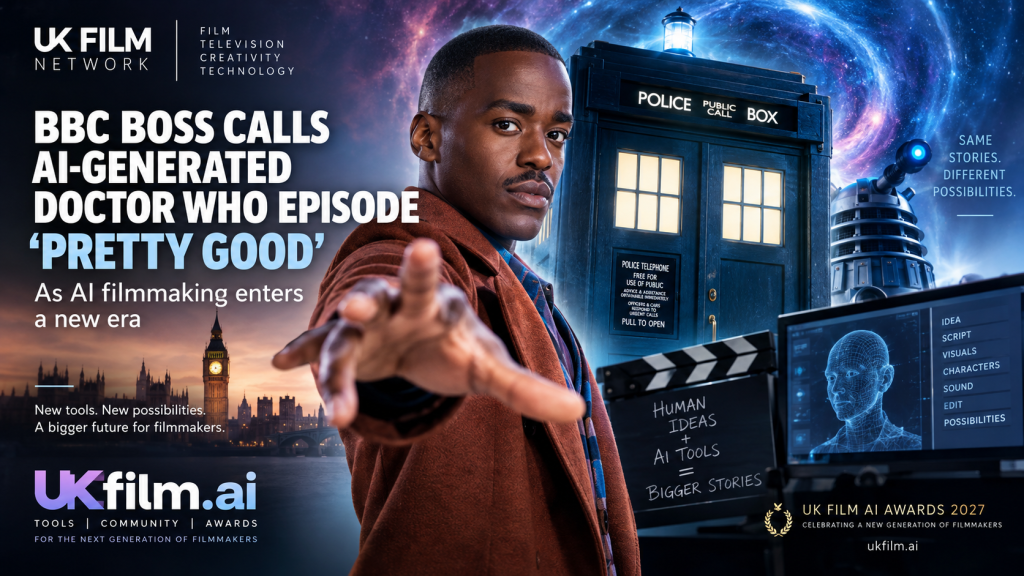
BBC Director-General Matt Brittin has praised an unofficial 50-minute AI-generated episode of Doctor Who, highlighting how rapidly artificial intelligence is changing the possibilities for independent filmmakers, while raising fresh questions about the future of television production.
Artificial intelligence has been steadily transforming the tools available to filmmakers, but remarks from the BBC’s Director-General suggest that the technology is now beginning to challenge long-established assumptions about who can produce broadcast-quality entertainment.
Speaking at the Royal Television Society’s London Convention, Matt Brittin revealed that someone had recently sent him a 50-minute episode of Doctor Who created entirely using artificial intelligence. His verdict was surprisingly positive: “It’s pretty good.”
Brittin, who joined the BBC following a senior career at Google, acknowledged the extraordinary creative capabilities now becoming available to ordinary people. He suggested that billions of people potentially have access to technology capable of producing content approaching the technical standards of major Hollywood studios.
He was equally clear, however, that artificial intelligence would not simply replace human creativity. His comments reflected a growing recognition across the entertainment industry that AI may dramatically change how content is produced without necessarily removing the people responsible for its ideas, performances and storytelling.
The episode in question was not an official BBC production, and there is no indication that the broadcaster commissioned, authorised or intends to release it. Nevertheless, the fact that a complete 50-minute AI-generated interpretation of one of Britain’s most recognisable television franchises reached the desk of the BBC’s most senior executive is remarkable in itself.
From Experimental Clips to Complete Stories
Until relatively recently, generative video technology was largely associated with short demonstrations, surreal imagery and visually impressive sequences that struggled to maintain consistency between shots. Creating a convincing character across multiple scenes, sustaining a coherent narrative or producing natural dialogue presented significant technical challenges.
That situation is changing rapidly.
Modern AI filmmaking platforms increasingly allow creators to develop characters, generate locations, animate performances, produce dialogue, compose music and assemble visual sequences without the traditional infrastructure required for a conventional production.
The arrival of tools such as Google Veo, Runway, Kling AI and OpenAI’s Sora has expanded the possibilities for generating moving images, while services including ElevenLabs, Suno and established editing applications provide additional capabilities for dialogue, soundtracks and post-production.
Yet generating an attractive image or a convincing cinematic sequence is only one part of making a film. Maintaining continuity, developing characters, controlling dramatic pacing and delivering a satisfying conclusion still require considerable creative judgement.
A 50-minute production is therefore an interesting milestone, although Brittin’s brief assessment provides little evidence of its wider artistic quality. We do not know who created the episode, how much human intervention was involved, what production tools were used or whether its characters and performances replicated existing copyrighted material.
Those questions matter, particularly when dealing with an established television property such as Doctor Who.
What Does This Mean for Actors, Writers and Film Crews?
The growing accessibility of AI production tools presents both opportunities and legitimate concerns for the creative industries.
For independent filmmakers working with limited budgets, AI offers the possibility of developing ambitious ideas that might otherwise remain unproduced. Science fiction, historical drama, animation and fantasy have traditionally required considerable financial resources, particularly when elaborate locations, complex effects or large casts are involved.
A filmmaker may now be able to visualise an ambitious screenplay, create a convincing environment or develop an experimental short film using resources previously available only to much larger productions.
However, the implications for professional actors, writers, composers, production designers and technical crews cannot be ignored.
Questions surrounding consent, likeness rights, copyright ownership, training data and the use of synthetic performances remain central to the industry’s debate. The ability to recreate a familiar character or imitate an actor’s appearance does not automatically establish the legal or ethical right to do so.
There is also an important distinction between using AI to support a creative production and using it to replace the contributions of professionals whose skills, experience and livelihoods have traditionally sustained the industry.
The most interesting future may not be one in which artificial intelligence replaces filmmaking, but one in which filmmakers combine human creativity with increasingly sophisticated digital production tools.
A New Opportunity for Independent Filmmakers
For the independent filmmaking community, the significance of AI extends well beyond the ability to imitate a major television production.
One of the industry’s longstanding barriers has been the gap between having a compelling idea and securing the money, equipment, personnel and distribution needed to bring that idea to an audience.
AI could narrow that gap considerably.
A writer with a strong science-fiction concept may be able to produce a convincing proof of concept without first securing a substantial visual-effects budget. An animator could develop an original world with a small creative team. A director might use synthetic environments to explore ambitious sequences before committing to expensive live-action production.
These developments do not make storytelling easier in every respect. In fact, as technical barriers fall, the importance of originality, character development and narrative discipline may become even greater.
When more people can produce visually sophisticated content, audiences will have more to choose from. Technical polish alone will become less of a distinguishing feature.
The films that stand out will still need to offer something worth watching.
UKfilm.ai: Helping Filmmakers Explore the New Technology
Recognising these changes, UK Film Network has launched UKfilm.ai, a dedicated platform supporting filmmakers, storytellers and creative professionals who want to explore artificial intelligence in film production.
The platform includes a growing AI Filmmaking Tools Directory, designed to help creators navigate the rapidly expanding landscape of generative video, character creation, screenwriting, storyboarding, voice technology, music, sound design and post-production.
Rather than requiring filmmakers to research dozens of different services independently, the directory brings together tools and practical workflows covering the filmmaking process from initial concept to completed production.
Visitors can explore individual technologies, compare their potential applications and discover suggested combinations of tools for different production approaches, including AI animation, cinematic filmmaking and projects created by individual filmmakers.
The objective is not to promote AI as a replacement for traditional filmmaking skills, but to make emerging technologies more accessible to filmmakers who want to experiment, develop new techniques and expand what they can achieve.
UK Film AI Awards 2027: Celebrating the Next Generation of Filmmakers
Alongside its tools directory, UKfilm.ai is preparing the inaugural UK Film AI Awards 2027, taking place at London Film School on Sunday 23 May 2027.
Presented by UK Film Network, the event will celebrate filmmakers using artificial intelligence as a meaningful part of their creative process, whether their productions are generated entirely through AI or combine AI techniques with conventional live-action filmmaking.
The awards will select ten short films for a London screening, recognising originality, storytelling and creative vision rather than simply rewarding technical experimentation.
The standard short-film category welcomes productions between three and ten minutes in length, while longer AI films may also be considered for selection and awards outside that category. International submissions are welcome, and filmmakers can enter directly through UKfilm.ai or via FilmFreeway.
Early-bird entries are currently £10 until 30 November 2026, with event tickets also available from £10 during the early-bird period.
The awards reflect a straightforward principle: technology may change how a film is made, but the quality of the story remains central to its success.
Filmmakers interested in participating can find further information, submission details and tickets at www.ukfilm.ai.
The Future of Film Is Still About Storytelling
Matt Brittin’s reaction to an AI-generated Doctor Who episode may prove to be a small but revealing moment in television’s technological evolution.
The BBC has not announced plans to replace established programmes with AI productions, and it would be premature to suggest that generative technology is ready to reproduce everything involved in professional television drama. What the episode demonstrates, however, is that the boundary between amateur experimentation and sophisticated screen production is becoming increasingly difficult to define.
For broadcasters and studios, that raises important questions about production economics, intellectual property, talent and the future structure of the industry. For independent filmmakers, it creates an opportunity to experiment with ideas that might once have been financially or technically impossible.
Artificial intelligence will undoubtedly produce its share of forgettable films, questionable imitations and technological gimmicks. The same tools, in the hands of inventive storytellers, could also help create original work that would never otherwise have reached the screen.
The real test will not be whether a computer can generate 50 minutes of Doctor Who. It will be whether filmmakers can use these new capabilities to create characters, worlds and stories that audiences genuinely care about.
And that is precisely the creative challenge that platforms such as UKfilm.ai and the UK Film AI Awards are encouraging filmmakers to explore.
Explore the technology: UKfilm.ai Filmmaking Tools
Enter the awards: UK Film AI Awards 2027
UK Film Network has supported independent filmmaking since 2007. Through UKfilm.ai, it is extending that mission to the emerging generation of AI-assisted and AI-generated filmmaking.